OCTOBER 5, 2026 · JAMES HAHN
- REVOPS
- GO-TO-MARKET
RevOps Grew Up. It's the Engine Behind the Whole GTM.
Revenue Operations was born inside Sales Operations. Today it touches recruiting, HR, marketing, customer success, delivery, billing, AI, and the board. Here is how far the job has really stretched, and why it matters.
Revenue Operations didn't start as a grand strategy. It started as Sales Operations: the person who cleaned up the pipeline report, fixed the territory spreadsheet, and got the quota numbers to tie out before the Monday call.
That job still exists. But if you look at what effective RevOps does today, the old name doesn't fit anymore. The role has grown into the engine that keeps the entire go-to-market running, from the day a seller is recruited to the day the cash lands in the bank, and then all the way up to the board deck.
The DNA never changed
The best RevOps people I've worked with share the same five traits, and they came straight from Sales Ops:
- Data driven. They trust the number, and they know when the number is lying.
- Critical thinkers. They ask "why is that true?" before they build anything.
- Driven to help others. The job is service. Your customers are the sellers, marketers, and CSMs who need to hit their goals.
- Technology savvy. They live in the CRM, the data warehouse, and now the AI tools.
- Process driven. If it happens twice, it should be a process. If it happens ten times, it should be automated.
That combination is rare, and it turns out to be useful far outside of sales.
Then the circle got bigger
Once a team can see the numbers, fix the process, and build the tools, every other function starts knocking on the door. First it was marketing, then customer success, then anything touching a sales motion. Today the picture looks like this:
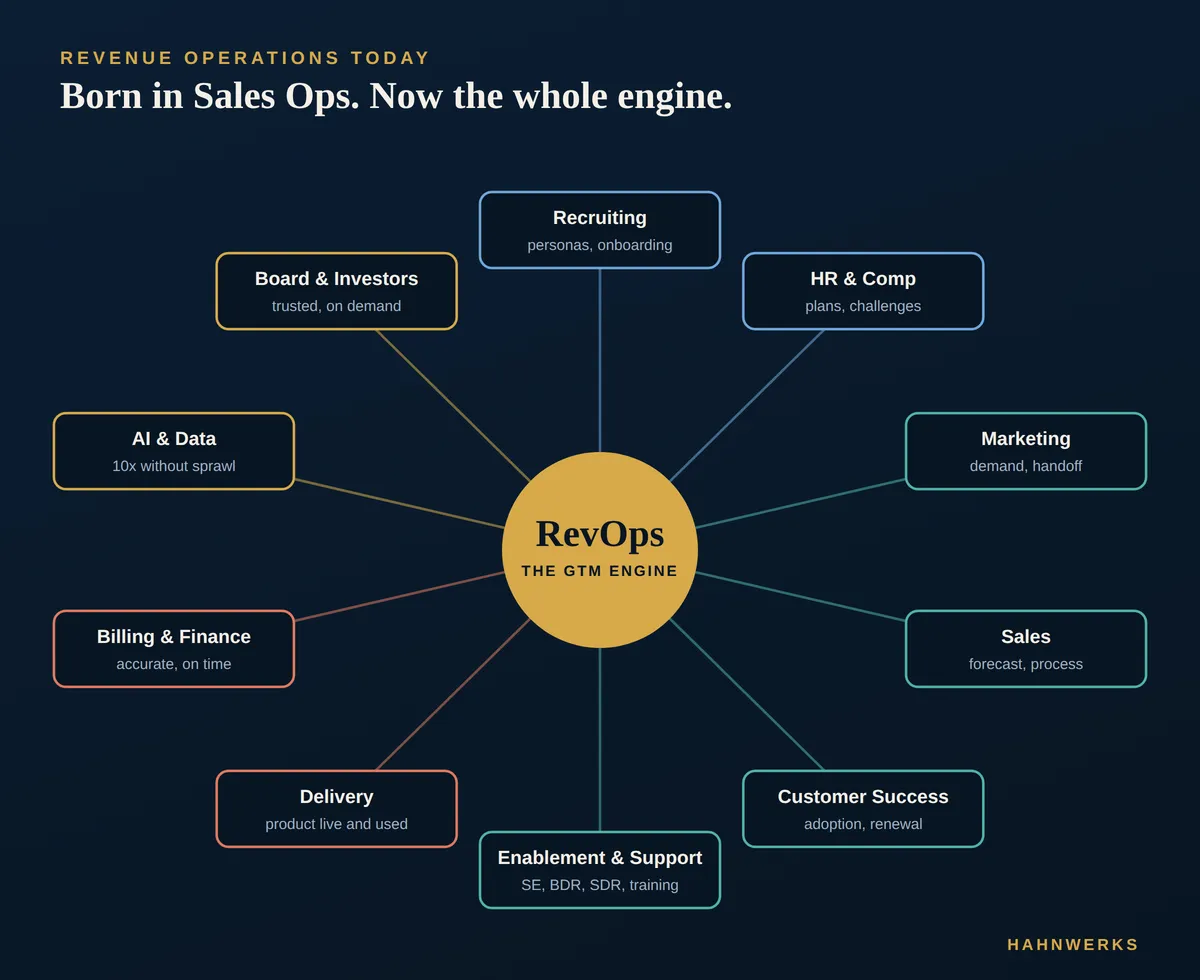
Let me walk through the spokes, because each one is a real job, not a buzzword.
Recruiting: the engine starts with the hire
Great revenue teams are built, not found. RevOps shows up in recruiting to define the sales hire personas (what does a top performer in this segment actually look like, based on the data?), to make sure onboarding is correct from day one, and to make sure the ops setup is ready so a new seller isn't waiting three weeks for a login, a territory, and a quota.
HR: where sales plans meet reality
Sales compensation is one of the hardest problems in the company. The plan has to motivate the right behavior, be affordable, be understood by the people on it, and be kept confidential until launch. RevOps partners with HR and Finance on plan design, on the edge cases and disputes, and on the quiet fact that a bad plan will quietly steer your whole team in the wrong direction. I've designed and rolled out comp plans at several companies, and the lesson is always the same: people do what the plan pays them to do.
The traditional teams, and everyone who supports them
Marketing, sales, and customer success are the obvious ones. RevOps gives them one definition of qualified, one system of record, and one forecast. But the list keeps going: enablement, training, learning, solutions engineers, BDRs, SDRs, business development. Every one of those teams needs data, tooling, process, and a way to show that what they do moves revenue.
Delivery: revenue isn't real until the product is used
Selling it is half the job. If the product isn't delivered and adopted, the renewal is at risk and the expansion never happens. So RevOps has to support the delivery and services functions too: capacity visibility, project-to-revenue mapping, and a clean handoff from sold to live. A booking you can't deliver on time is a future problem with a nice-looking number on it.
Collect the cash
This is the part that gets the least glamour and causes the most pain. If invoicing and billing aren't accurate and timely, you've done all the hard work of winning the deal and then made it hard to get paid. At Omilia I took billing review over from Finance, and reconciliation went from three weeks to five days. That wasn't a technology win. It was a process win that happened to need a data warehouse.
AI: 10x the team without 10x the mess
Every revenue leader is being asked to use AI to do more with the same team, and RevOps is usually the group asked to make it real. It's also where the hype is most dangerous.
Gartner's July 2026 research predicts AI agents will outnumber sellers 10 to 1 by 2028, and yet fewer than 40% of sellers will say the agents actually improved their productivity. Their analyst Dan Gottlieb put the risk plainly: without the right data foundation, workflow integration, and seller experience, sales leaders risk "agent sprawl, with more digital activity, but little improvement in seller impact." The same research found that chief sales officers who overhaul their data, automation, and user experience are five times more likely to get a return on AI. (Gartner surveyed 210 chief sales officers and senior sales executives in early 2026.)
That matches what I've seen. AI is only as good as the system it sits inside. The RevOps job is to build that foundation, then push the strategy and the tooling all the way down so the GTM is being executed consistently by every team in the company, not just the ones closest to the CRM.
Reporting on demand, and a board that trusts it
All of this rolls up to one thing: accurate, actionable reporting, available when someone asks for it. The board and the investors need data they can trust, and the CEO needs to be able to ask a question on Tuesday and get an answer on Tuesday, not a spreadsheet next week.
Trust is the real product here. Data accuracy keeps showing up as a top challenge for revenue leaders (Forrester research, as reported by Bitscale, puts it at 38%). Fix that, and everything downstream gets easier: forecasting, planning, hiring, comp, and the board conversation.
So what is RevOps now?
It started as a sales support function. It's now the operating system for how a company goes to market, finds its revenue, delivers on it, collects it, and explains it. The people who do it well still have the same DNA: data driven, critical thinking, helpful, technical, and process obsessed.
If your RevOps team is still being treated like a reporting desk, you're leaving the engine idling. Where has the job stretched the furthest in your organization: people and comp, delivery, billing, or AI? Tell me on LinkedIn. If you want help building it, let's talk.
LET'S TALK
Book a 30-min call.
Thirty minutes on the forecast, the CRM, and the handoff between sales and finance.
ABOUT THE AUTHOR
I'm James Hahn, a Revenue Operations executive. I build investor-ready revenue systems for high-growth companies, from the next funding round to the IPO, and I was part of the teams behind Zendesk's IPO, AppDynamics' $3.7B sale to Cisco, and Riskified's 2021 NYSE listing. I am available for full-time executive roles and advisory roles, plus select fractional and interim engagements.
More about me →